About Immunization Technical Support Unit (ITSU)-MoHFW
India runs the largest immunization programme globally.India’s Universal Immunization Programme (UIP) is the largest in the world, catering to an annual birth cohort of 2.57 million infants and 2.9 million pregnant women through around 13 million sessions throughout the country across 36 states and UTs. Despite the tremendous range in disease burden across different states and regions of the country, India’s pathway to achieving national immunization goals over the past decade has witnessed promising achievements, the most noteworthy being the expansion of the bouquet of immunization services with the introduction of new vaccines, increased budgetary allocation, greater focus on immunization research, innovations and technological advancements, with all key stakeholders having a role to play.
Formation of Immunization Technical Support Unit
The ministry of Health & Family Welfare declared 2012 as the Year of Intensification of Routine Immunization (RI). When the Universal Immunization Programme (UIP) was launched in the year 1985, there was a growing recognition for achieving full immunization by adopting ‘whole-of-county’ and a ‘whole-of-society’ approach that included the government at the central and state -level and most importantly the grassroots presence of civil society and participation of the private sector. It was also a time when the scope and role of international partners, donor agencies and specially constituted bodies was being defined for achieving the targets.
To support the Government of India to achieve the immunization targets of national and sub-national coverage, the Immunization Technical Support Unit (ITSU) was set up in 2012 as an alliance involving the Ministry of Health & Family Welfare (MoHFW), Gates Foundation, and Public Health Foundation of India (PHFI), to serve as a strategic think-tank, providing techno-managerial support for scaling up the Universal Immunization Programme (UIP) in the country.
ITSU was created to rapidly augment the capacity of the Immunization Division of the MoHFW, in response to the recommendation of the Mavalankar Committee Report, with a clear consensus on the gradual uptake of ITSU’s critical interventions by MoHFW, to ensure the sustainability of its technical unit.
In June 2017, ITSU was transitioned from PHFI to John Snow India (JSI) with continued funding from the Gates Foundation (previously BMGF). Since its inception, ITSU’s support and programmatic interventions have been strategically designed towards improving the national Routine Immunization (RI) coverage, placing equity and quality at the centre of all its interventions, strengthening health systems and generating evidence to guide policy decisions, that have deeply contributed to achieving significant gains under the UIP
ITSU’s Current Status and Scope of Work
ITSU, in existence since 2012, first with the Public Health Foundation- India (PHFI) and since 2017 being managed by John Snow India Private Limited (JSIPL) has been serving as an extended arm of the MoHFW for strategic planning to innovate, demonstrate and document best practices across the country and facilitate the government in scaling-up the UIP. ITSU also assists all the states and union territories (UT) to address coverage, equity and quality related barriers in increasing the reach of India’s immunization program. ITSU has worked relentlessly and made some significant contributions to MoHFW achievements in the immunization programme.
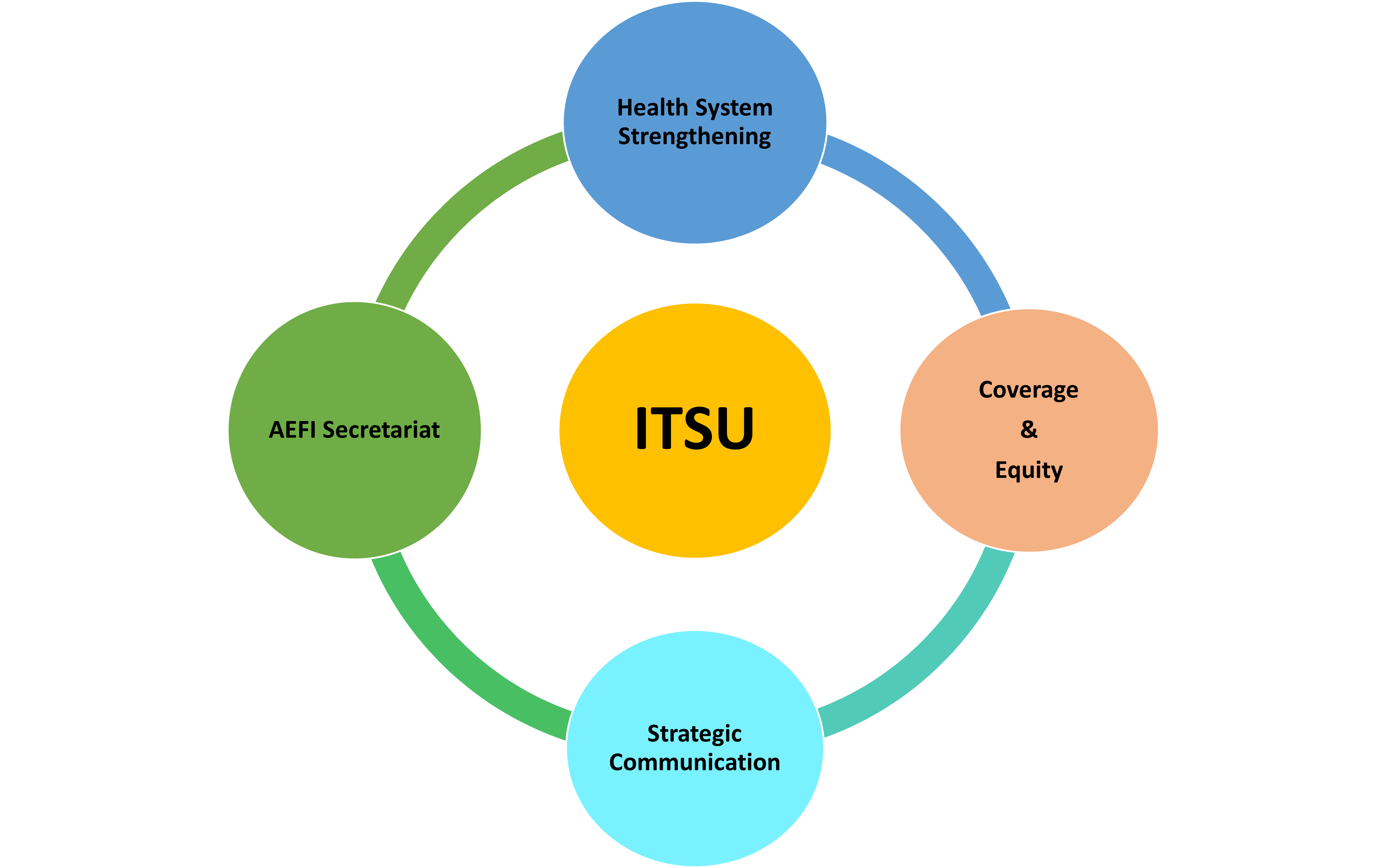
ITSU’s Major Interventions
RI Intensification
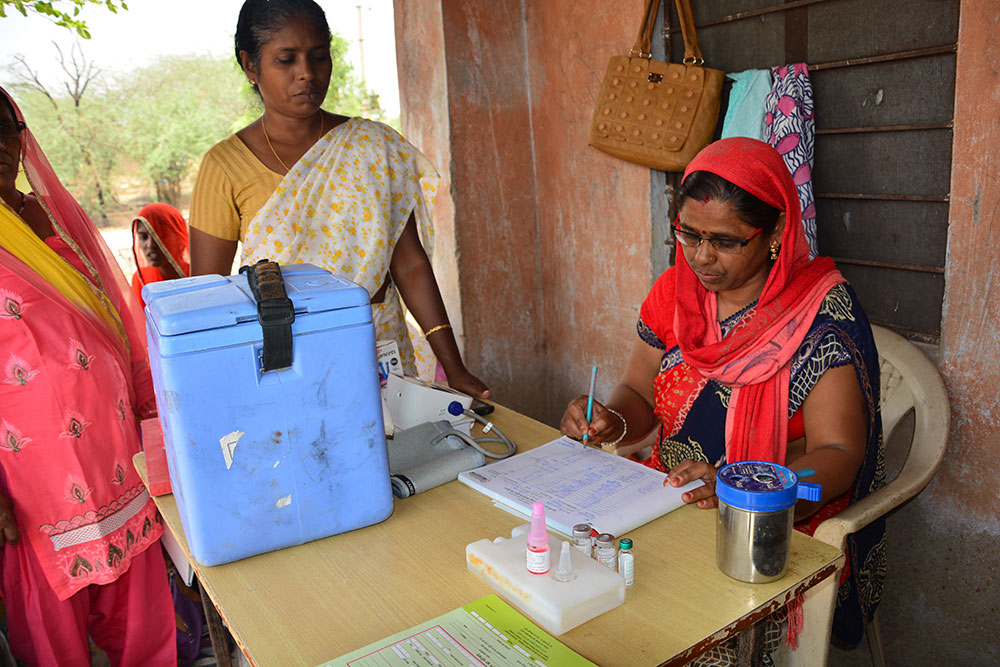
ITSU has steered the design and implementation of Mission Indradhanush (MI) and Intensified Mission Indradhanush (IMI) since 2014. The flagship programme “Mission Indradhanush” branded under the aegis of ITSU has been globally recognized as one of the most successful campaigns targeted to bring about behaviour change among critical stakeholders. ITSU has led interventions in microplanning, cold chain and vaccine logistics and monitoring at the state, district and block levels. In its efforts to bringing RI to the centre-stage, ITSU has set up AEFI Secretariat, devised communication strategies encompassing evidence- based IEC and SBCC tools, developed technical and operational guidelines and supported on field national monitoring interventions for the MI.
System Strengthening Through Aggressive Review and Monitoring Interventions
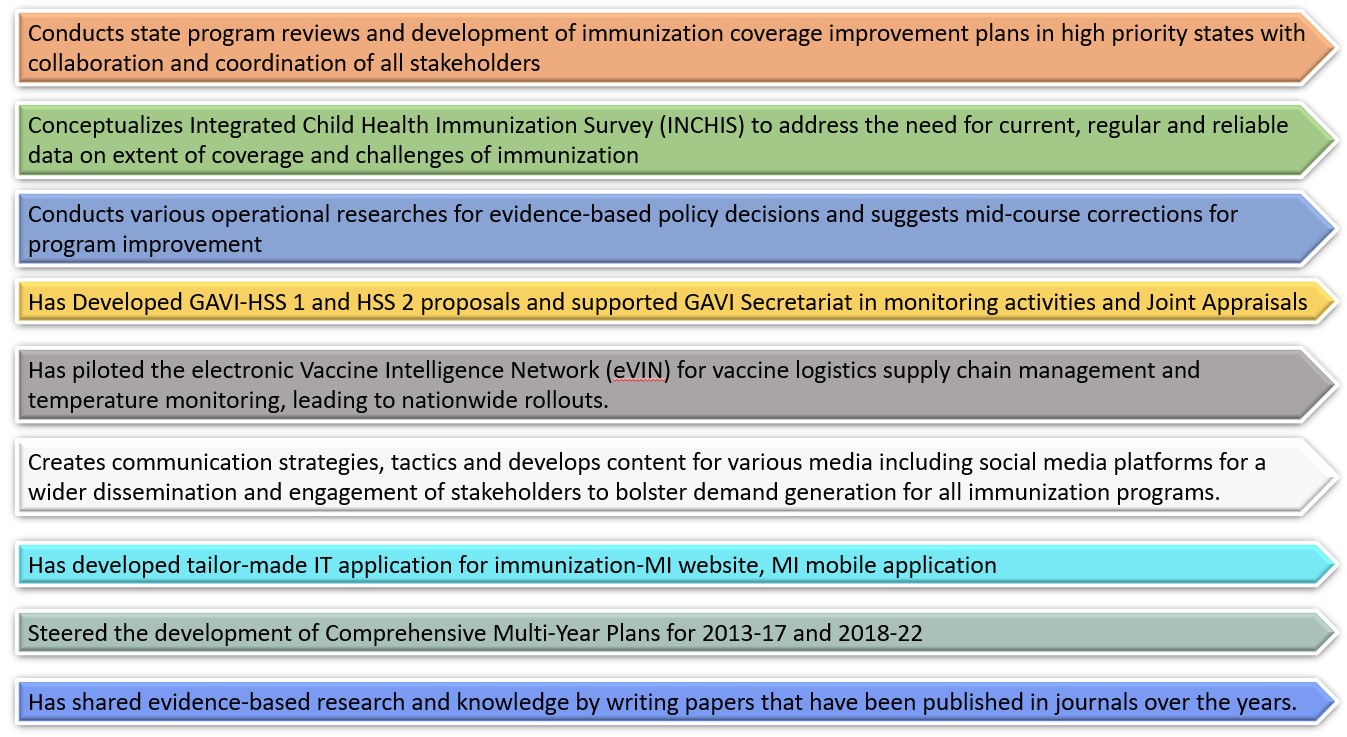
ITSU has steered the rollout of regional and state level workshops and Training of Trainers (ToTs) to monitor progress, undertake Comprehensive UIP Reviews and foster deliberations on the development of immunization coverage improvement plans (iCIPs). ITSU has also been a at the forefront of tracking states’ progress and disseminating the same with MoHFW (and states) through quarterly reports. In sync with the government’s priorities, ITSU has been placing enhanced focus on strengthening urban and tribal interventions, outlined through periodic reviews with National Urban Health Mission (NUHM) and partners, pilot interventions and development of micro plans.
Bolstering National and Sub-National Capacities
ITSU plays a critical role in supporting the government towards strengthening health systems by building capacities on the core components, contributing to improved RI coverage. These include development of iCIP, AEFI modules, data recording & reporting and communication. ITSU has also been at the forefront in assisting MoHFW in the development of Programme and Policy Committee (PPC) documents and Joint Appraisal reports for GAVI, conducted EVM assessment and strengthened cold chain and vaccine management in support of National Cold Chain & Vaccine Management Resource Centre (NCCVMRC).
Strengthening Data Use and Action
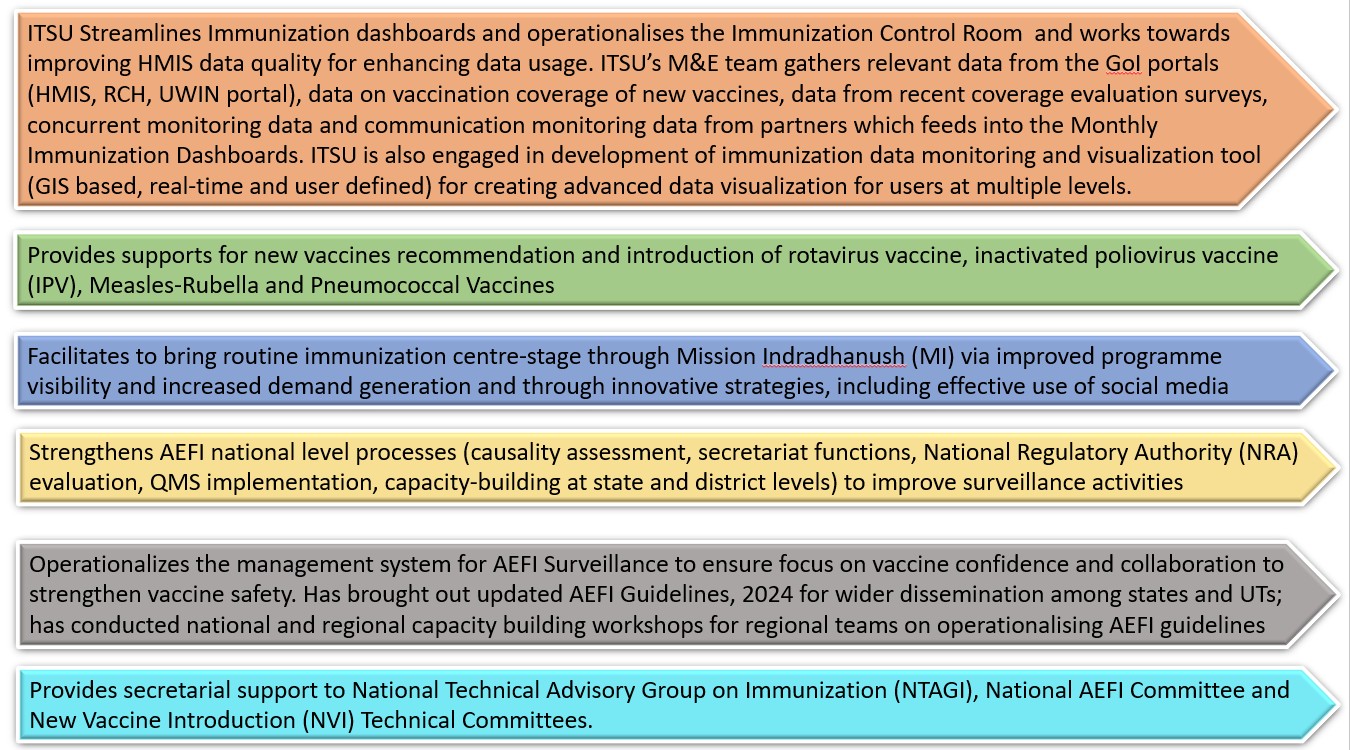
ITSU hosts the Immunization Control Room to collect, collate and analyse immunization data, prepare data repositories and provide feedback to MoHFW and states for use and further action. ITSU has helmed data quality assessments( DQA), developed monitoring and diagnostic tools and operationalised immunization dashboards with state-wise fact sheets, maps and graphs shared on a monthly basis with states and partners. In its efforts towards strengthening national monitoring mechanisms, the development of a robust Immunization data monitoring and visualization tool iDAP ( Immunization Data Access Platform ) is currently underway at ITSU.
Building evidence to support policy
ITSU maintains a data bank of policy evidences which serves as nidus in designing various system strengthening models like Electronic Vaccine Intelligence Network (eVIN), and has been a key player for its expansion across states. Integrated Child Health and Immunization Survey ( INCHIS) was conducted in 2016 with the objective of getting data on immunization coverage and its determinants , to assess the availability , functionality and quality of immunization services and to evaluate the impact of Mission ITSU conducted an the economic comparative study on Rotasil and Rotavac.
Human cantered design approach has formed a critical component of ITSU driven researches. In 2016-17, the first-ever vaccine hesitancy study in the country was led by ITSU, which aimed to identify optimal interventions and strategies to counter hesitancy barriers in the country. In addition, providing support to the government for improved immunization coverage among adolescents, ITSU led formative researches and sketched guidelines proposing strategies to strengthen the same.
Guiding in strategic planning for improved coverage outcomes
The Government, through ITSU steered the development of its vision document – ‘Comprehensive Multi-Year Plans (cMYP) for 2013-17 and 2018-22’, which outlined the objectives and strategies related to core programmatic areas. ITSU has also led the development of the Roadmap to achieve 90% FIC – a guidance document, to guide states and districts in fast-pacing their efforts towards improving and sustaining coverage. As an active member of various key committees set-up to support evidence-based decision-making, ITSU has been a major player in assisting critical government led actions such as the replacement of TT with Td vaccine.
Expansion of bouquet of immunization services with the introduction of new vaccines
ITSU has supported new vaccine introduction (Td, PCV, RVV, MR, IPV Vaccine) and its expansion by developing operational guidelines, factsheets, drafting scale-up plans, IEC / communication tools and facilitated trainings as part of national and state level Training of Trainers (ToTs).
Vaccine Safety
ITSU houses the National AEFI Secretariat which extends techno–managerial support to the National AEFI Committee and MHFW for informed decision-making and review of policies and recommendations. Through the Secretariat, the Unit has been steering Causality Assessments, reviews and AEFI Committee meetings (nat./state), developed technical guidelines/resource aids and supported the ministry in implementation of Quality Management System-AEFI across states in a phased manner. In addition, ITSU carries out special investigations of cluster deaths and hospitalizations.
Strategic Communication Intervention for Demand Generation
ITSU lends support on strategic communication on IEC and SBCC interventions for demand generation for RI and during special campaigns (i.e., MI, IMI, MR, Zero doze etc.). It brings out a quarterly newsletter: Immunization-India Update that shares an update on activities, best practices and important perspectives; manages social media platform, vaccinate4life for X and Facebook by creating useful content and engaging with stakeholders; tracks online news media on everyday basis and shares fortnightly media analysis with MHFW and other stakeholders; curates innovative communication strategies and interventions and shares hands-on-skills at macro and micro levels in Operational Guidelines on various areas of immunization; contributes in capacity building during AEFI national and regional workshops in areas of communication and media, besides being active in inter-vertical joint tasks.
Highlights of ITSU’s Tasks
In a nut shell
- Strengthening program implementation by anchoring national and state implementation teams to formulate immunization strategies and field activities.
- Revitalizing investments in strategic communications by including advocacy and targeted messaging; social and community mobilization; strategic information, education and communication activities; and media outreach for tackling disinformation.
- Stepping up AEFI case investigation by improving AEFI reporting and setting up systems for supporting state and district AEFI committees to record cases.
ITSU has contributed to improving vaccination coverage across the country by reaching the unreached by generating evidence; by providing technical support to the government and enhancing the uptake of immunization in equitable and progressive ways.