

Rethinking urban immunization to reach out to the urban poor
Outbreaks of Vaccine Preventable Diseases (VPD) are more common in urban slums owing to high population density and continuous influx of a new pool of infective agents with the immigrating population. The lack of social fabric in urban slums often limits interpersonal interaction and information about services. Urban poor invariably are not always able to muster enough confidence to access services even when services are proximal. Working mothers do not get the support required to attend to their child’s health needs when they are occupied in livelihood generation activities.
Evidence suggests that poor uptake of immunization in urban areas is often associated with an average mother’s lack of awareness about repeat visits to achieve complete immunization rather than overall vaccine awareness. Slum dwellers are unable to demand services owing to weak community organisation and low collective confidence which is known to increase utilisation of health services. Immunization programmes in urban areas can exert significant effects on VPD associated mortality by limiting number of cases, decreasing clustering of cases within households and increasing time lapse between outbreaks.
The urban poor population is most vulnerable and deprived when it comes to accessing health care services like immunization. With low immunization coverage in urban and peri-urban pockets, slums and illegal squatter settlements are at a high-risk for outbreaks of VPDs resulting in high morbidity and mortality among infants, children, adolescents and pregnant women. The management of these situations is both challenging and resource-intensive.
The findings of the National Family Health Survey (NFHS)-5 reflect a marginal deterioration in immunization coverage in urban areas. Proportion of fully immunized children, which was marginally higher in urban areas from national and rural averages as per findings of the NFHS-4 survey showed an inverted pattern in NFHS-5 with proportion in urban areas less than both the national as well as rural average.
Fact file
- India’s urban population increased from 25.5% in 1990 to 34.9% in 2020
- Overall, urban growth is expected to contribute to 73% of the total population increase by 2036
- Full immunization drive among children aged 12-23 months recorded substantial improvement from 62% to 76% at all-India level
- 11 out of 14 States/UTs have more than three-fourth children aged 12-23 months with full immunization and it is highest (90%) for Odisha
Source: National Family Health Survey (NFHS)-5
2019-2021
ITSU’s Foray in the Realm of Urban Immunization
Increased urbanization has created a pressing need for innovative immunization strategies and guidelines specifically developed for urban populations. As a part of its work in the area of urban immunization, the PI unit has provided technical assistance to states for prioritization of urban areas.
The PI team has formulated strategies for strengthening the urban immunization program based on pilot projects implemented in Rajkot (Gujarat) and Jabalpur (Madhya Pradesh). Strengthening urban immunization data mapping and updation for NUHM cities and generation of urban immunization dashboards is an ongoing process.
The PI unit also develops the monthly Urban Immunization Dashboard for the National Urban Health Mission (NUHM) cities prior to sharing the same with States/UTs through MoHFW.
ITSU’s NUHM assessment of Nine states
Historically, urban Full Immunization Coverage ( FIC) has always been higher than the rural and national averages. But NFHS -5 ( 2019-21) has reflected a concerning trend wherein urban immunization rates are lagging behind, reversing the previous pattern. In comparison to the NFHS-4 ( 2015-16), the rural regions recorded a 15.5 % increase in the FIC, while only an 11.6 % increase was reported in the urban regions.
ITSU-MoHFW conducted Comprehensive UIP ( CUIP ) review of NUHM Cities to assess the gap in systems and process of cities/ corporations of the country in 4 main thematic areas-Programme planning including implementation, Demand generation, Logistics and supply chain management, and Programme Monitoring and Evaluation from February – June 2024 in 9 NUHM cities of 9 States including Raipur ( Chhattisgarh), Udaipur ( Rajasthan), Amritsar (Punjab), Indore ( Madhya Pradesh), Thane ( Maharashtra), Visakhapatnam ( Andhra Pradesh), Chennai (Tamil Nadu), Thiruvananthapuram ( Kerala) and Goa. A comprehensive report was prepared and shared with concerned states. The states were also supported in the development of Immunization Coverage Improvement Plan ( ICIP) for urban areas.
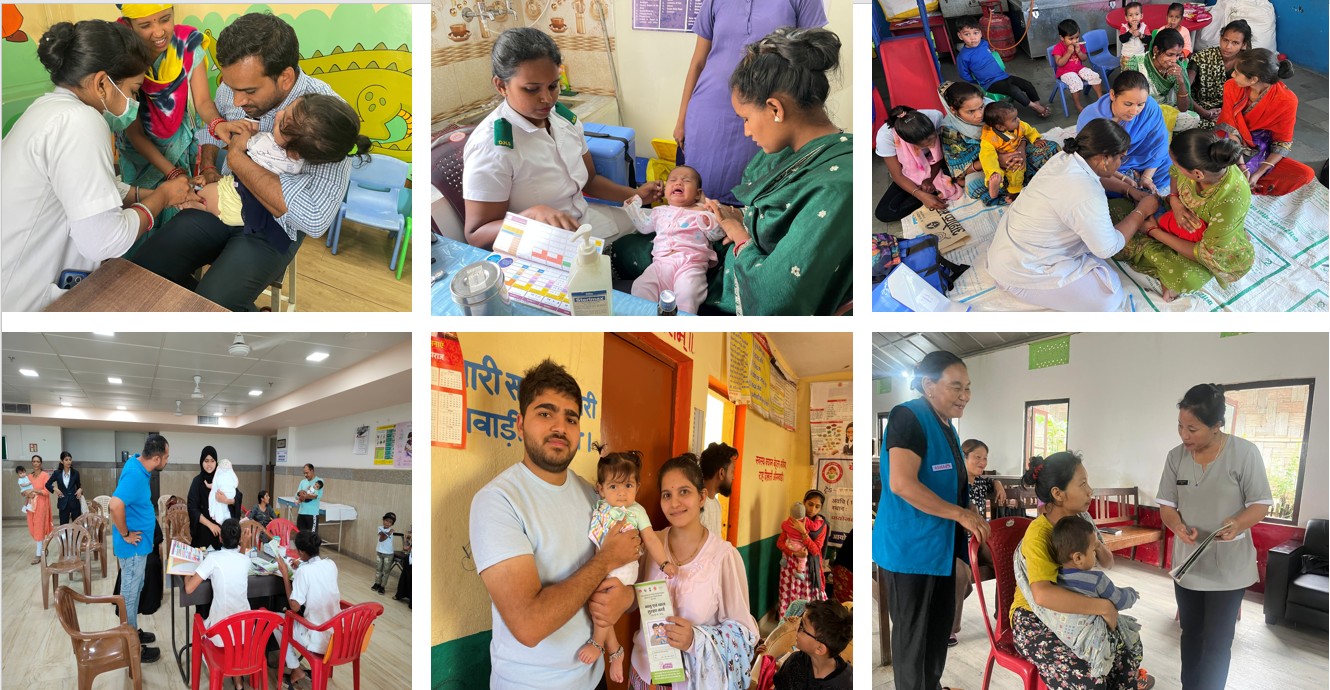
ITSU also supports the urban immunization project (URZA) with the aim of strengthening the overall urban health system with emphasis on immunization services among vulnerable population residing in Bihar and Uttar Pradesh.
A 5D approach was followed to reach the unreached population and to improve vaccination coverage and equity in the project states. The approach included co-designing new approaches to reach out to pockets of missed, resistant or under-served communities, and establish and streamline review mechanisms and data management systems for local decision making to strengthen immunization systems.
The project also employs a human - centred approach to reach Zero Dose children under the Zero Dose Learning Agenda (ZDLA). The approach systematically identifies and addresses factors contributing to zero-dose children, with an integrated continuous learning strategy built within the implementation framework, using a 3-D conceptual framework—Diagnose, Design, Deliver.